Launching a DEX always runs into the same problem:
No liquidity → no traders.
No traders → no liquidity.
Penumbra had just gone live on mainnet with a brand new private DEX. The protocol itself was incredibly powerful, but like every new exchange it needed a way to bootstrap liquidity quickly.
The Liquidity Tournament, the brainchild of our CEO, Henry de Valence, was a protocol-level incentive mechanism designed to solve that cold start problem. It used rewards from the community pool to encourage liquidity provision, while letting the community decide which trading pairs should be incentivized.
My role was to turn the concept into a shippable product: defining the product requirements, coordinating engineering and design, and establishing the product development process needed to deliver it.
The Problem
DEX launches have a classic marketplace problem.
Liquidity providers don’t want to deploy capital if nobody is trading.
Traders don’t want to use an exchange with thin liquidity.
On top of that, Penumbra introduced an additional dimension: privacy.
All trading activity takes place inside a shielded pool. The larger that pool becomes, the stronger the privacy guarantees are for every participant.
So solving the liquidity problem wasn’t just about better markets. It was also about strengthening the protocol’s privacy properties.
We needed a mechanism that would:
bootstrap liquidity quickly
encourage active trading
reward useful liquidity rather than idle capital
involve the community in directing incentives
The Mechanism
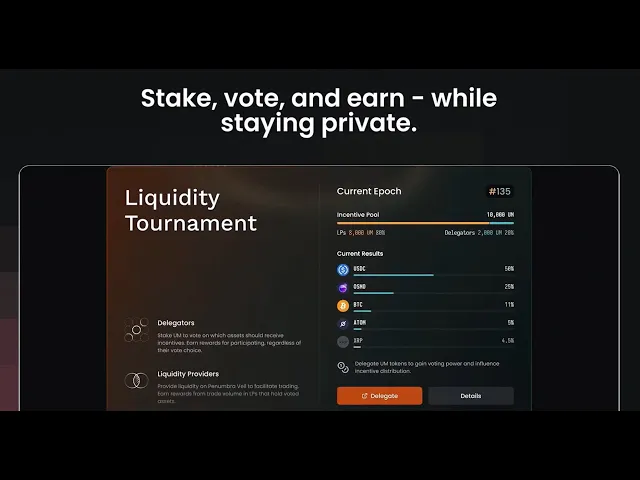
The Liquidity Tournament ran in rounds aligned with Penumbra’s staking epochs.
Each round distributed rewards from the community pool through two channels:
Delegators
Token holders could vote on which asset pairs should receive incentives.
Liquidity providers
LPs competed to provide liquidity on those pairs.
Rewards were distributed based on actual trading volume processed, not just how much capital someone deposited.
This design created an interesting dynamic:
LPs weren’t rewarded for parking capital in the pool.
They were rewarded for offering the most competitive prices and processing real trades.
The result was a system that encouraged deep liquidity and better market pricing at the same time.
My Role
The concept for the Liquidity Tournament originated with Penumbra’s founder.
When I joined the team, my responsibility was to turn that concept into a deliverable product.
The organization had historically shipped protocol features in a fairly ad-hoc way. But this was the first major piece of user-facing functionality, and it needed a more structured process.
I worked with the CEO and CTO to translate the mechanism design into a full product specification.
From there I coordinated across several groups:
protocol engineers implementing the incentive mechanics
frontend developers building the Veil DEX interface
design to ensure the user flows made sense for liquidity providers
marketing and community teams preparing the launch
In parallel, I established the internal product process for the team:
product requirements documentation
project planning and sequencing
cross-team coordination
launch readiness
It was essentially the first time the organization had run a full product cycle for a feature of this scale.
What We Built
The tournament introduced several new pieces of functionality to the ecosystem.
Delegators could vote each epoch on which asset pairs should receive incentives.
Liquidity providers could then open positions on those pairs and compete for rewards.
Behind the scenes, the protocol tracked how much trading volume each liquidity position processed and distributed rewards accordingly.
From a user perspective, this showed up as:
voting interfaces for delegators
liquidity provisioning tools in the Veil DEX UI
clear feedback on which pairs were being incentivized
The end result was a mechanism that turned the cold-start problem into a game the community could actively participate in.
Results
Once the tournament launched we saw a clear uptick in liquidity inflows and participation.
Delegators began voting on incentive allocations each epoch, and liquidity providers started competing for rewards on the selected pairs.
The mechanism did exactly what it was intended to do: it created momentum around the DEX at a critical moment in the protocol’s early lifecycle.
Unfortunately the organization shut down not long afterward for unrelated reasons, so the tournament didn’t get the chance to run as long as planned.
But the early signal was strong. Given more time, it likely would have become a core liquidity engine for the ecosystem.
Lessons
The biggest takeaway from this project was how important it is to bridge the gap between protocol design and product delivery.
A clever mechanism on paper doesn’t automatically translate into something users can understand or interact with.
Turning the Liquidity Tournament into a real product required:
translating mechanism design into clear user flows
coordinating multiple teams with different incentives
introducing product discipline into an engineering-heavy organization
It also reinforced a broader lesson that applies well beyond crypto:
Great systems don’t just solve technical problems.
They align incentives so that the right behavior emerges naturally.